
Brightland Olive Oils & Vinegars: A Mediocre Review
If you’ve been following our blog for a while, it won’t come as a surprise that we are uber nerds. 🤓 (If this is a surprise for you, then check out any of our 101 posts — Mac and Cheese 101, Garlic Bread 101, Chili 101, or Pizza 101.)
Recently we had the opportunity to sample a few different olive oils and vinegars from Brightland. So we did what we did best and set up a blind tasting experiment, invited some of our friends over, and took shots of olive oil and balsamic vinegar.
What follows is the results of our blind taste test.
Obligatory Disclaimer: Brightland sent us some of their olive oils and vinegars to test out free of charge (the Mini Essentials and the Mini Artist Series). This post contains affiliate links that help us earn a small commission from your purchase (at no extra cost to you). Each purchase supports the blog so we can continue to make content! If you use these links, we really appreciate it!
But First, A Bit About The Brand
Brightland is based out of California and produces high quality olive oil and vinegars. Their products are made with ingredients from family-run farms in the Golden State (olives, grapes, fruit, etc.)
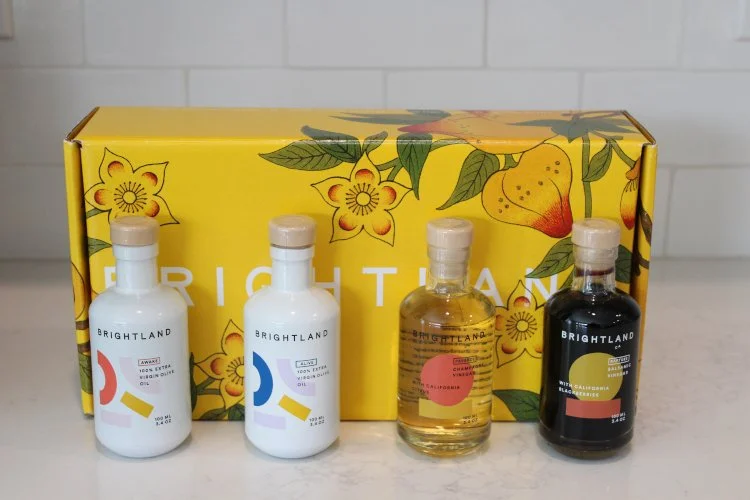
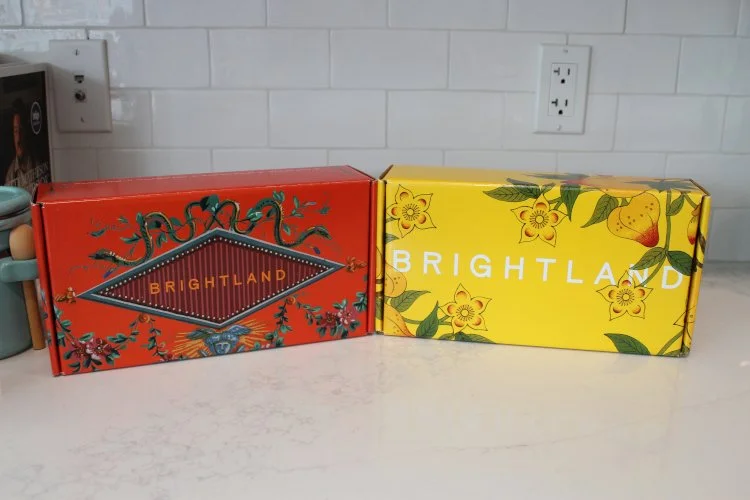
We love Brightland’s branding — it’s so well done! The vibrant illustrations on their bottles are beautiful, and the overall design is minimalistic and classy. They’re so pretty that you’ll want to display these on your kitchen counter.
If you buy one of their boxed gift sets for someone you love, you don’t have to wrap it. Just put a bow on it and you’re good to go.
Our Mediocre Experiment (The Taste Test)
We had lofty ambitions. We were going to do a double blind taste test. We were going to have so many different combinations of oils and vinegars. But then reality sunk in and we simplified.
What we did was choose five olive oils and got our friends to test them without knowing what they were. We picked two Brightland oils, a bottle of olive oil from Costco made with California olives, a bottle of olive oil imported from Italy, and another imported from Greece.

Doing shots of olive oil is an…interesting experience.
We also picked three balsamic vinegars for our friends to test as well — Brightland’s balsamic vinegar, a balsamic vinegar imported from Italy, and the most basic balsamic vinegar that Galen Weston sells.
We asked our friends to sample each one, write down their thoughts on paper, and then try to rank them if they could.

This is the official Mediocre Chef Taste Test Data Sheet™ that we passed out.
The main questions we wanted to try and get an answer to were:
What olive oil would you use as a “daily driver”?
What oil & vinegar did the group prefer?
Could they identify the cheapest olive oil and balsamic vinegar?
As with any experiment, there are limitations. For us, the biggest limitation is: how the hell do you cleanse your palate after slamming back a shot of olive oil?
Oil, by its very nature, will coat your mouth and is hydrophobic. So when you drink some water to try and wash it away, well, it just stays. Then you slam back another shot of oil. So when you drink the second oil and make notes, are you really tasting the second oil? Or are you tasting a hybrid of oil 1 and 2?
We didn’t really think about this until the day of, so we didn’t have a great solution to the problem. We kind of just went with it and hoped everything came out well in the end. 😅
Our Friends’ Thoughts
These are the answers to the above three questions, based on the notes our friends took:
The overwhelming opinion was that what oil should be your daily driver depended on the usage. If you just want an oil to cook things in, the Costco oil was the clear winner (because it didn’t taste like much, so it wouldn’t impact the flavor of the dish). If you want to use olive oil to dress a salad or drizzle on your dish, then the results were pretty well split between the Brightland olive oils and the oils from Greece and Italy.
As we said, the group was pretty well split on what their preferred olive oil was. Some people really preferred the earthiness of the Greek oil. Some people preferred Brightland’s peppery flavor. The only thing that the group agreed on is that the Costco olive oil was last place for taste, and for balsamic vinegar the clear winner was the imported vinegar from Italy.
In a move that isn’t at all surprising, our friends were able to pick out the Costco olive oil and the President’s Choice balsamic vinegar (the cheapest of the bunch). The biggest notes for the Costco olive oil is that it was essentially tasteless and President’s Choice vinegar was very, very, very acidic. Cheap products taste like cheap products. Quality matters!
Bonus Round: Flavored Oils and Vinegars
In addition to trying out the olive oils and balsamic vinegar from the Mini Essentials Kit, we also tried the champagne vinegar (but didn’t have anything to compare it to) and the flavored oils from the Mini Artist Series.
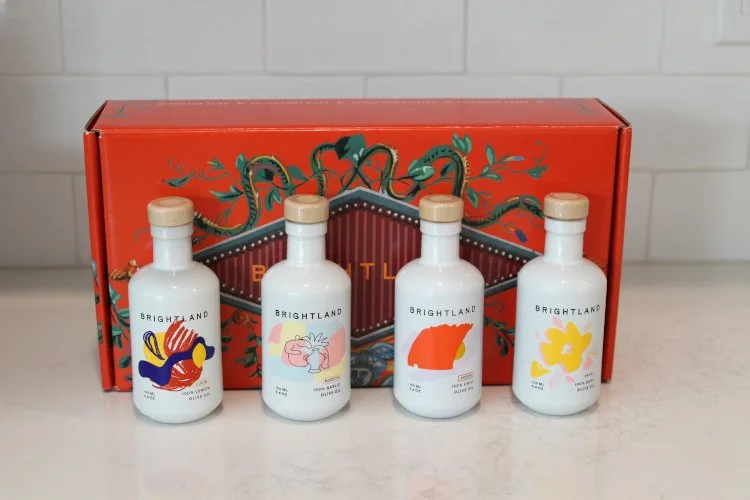
We had no desire to buy a bunch of flavored oils and do blind taste tests on those (see our above note about simplifying). Instead we just sampled these with some delicious bread and asked our friends what they thought. Here are the results:
Champagne vinegar = chefs kiss, no notes
Garlic oil = amazing
Lemon oil = amazing
Basil oil = tastes like pizza
Chili oil = one-note, not great 👎
Our Thoughts
👨🍳 Trevor: If you had told Past Trevor that one day he would be taste testing olive oils like it was a wine tasting, I’m pretty sure I would have laughed in your face. Yet, here we are. To be honest, until rather recently, I had never really thought about how different olive oils could taste, well, different. Of course I was aware that there are vast differences in quality that could lead to different tastes, but it wasn’t until I had sampled a bunch of different oils that I realized just how nuanced the flavors could get.
The same goes for balsamic vinegar. It was always a very acidic thing that you added a bit of to some dish. Then I tried some nice, aged balsamic and realized just how pleasant it can be. In terms of Brightland, it’s hard to pick a clear winner on anything — they’re all good in their own unique way (except for the chili oil which was just one-note). But, if I had to choose my favorites, I’d say probably the champagne vinegar and the lemon oil. Dipping a piece of crusty bread into that combination was one of the best things I’ve ever tasted in my life.
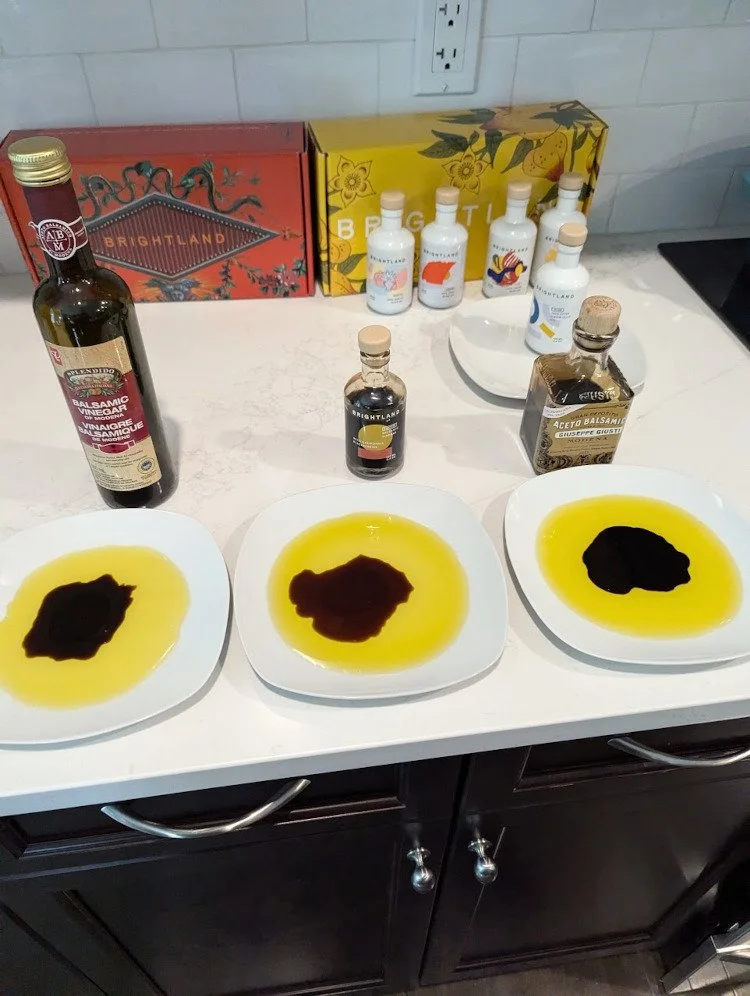
We also did some bread dipping. 🥖
👩🍳 Brittany: I am a huge olive oil and balsamic vinegar fan. I’ve been to Italy and have had the opportunity to taste both of these things straight from the source. I also frequent our local Italian grocer, and splurge every now and then on a fancy oil or vinegar. I’m no stranger to quality olive oil and balsamic vinegar!
That being said, I really enjoyed tasting and sampling olive oil and balsamic vinegar that’s from closer to home. If I had to only choose two things out of everything I tried, I’d go with the champagne vinegar and the garlic olive oil. Brightland’s balsamic vinegar was good too — it’d be great to make a salad dressing with (whereas I think the aged Italian vinegar we tried is best combined with olive oil for dipping bread).
One thing to note: the bottles don’t pour well on their own (they make a bit of a mess!), so it’s best to top them with a spout.
California Olive Oil vs Old World Olive Oil — Is There a Difference?
When we think of olive oil, we typically think of Italy, Greece, or even Spain. To be honest, we’ve been conditioned to think that Italian olive oil is the best. And don’t get us wrong, it is really really really good. But it turns out, California olives are pretty awesome too!
According to the California Olive Council (yes, that’s a thing), California grows more varieties of olives versus European countries. Meanwhile, another source says that Italy has the largest variety of olives in the world, with more than 500 different types. Who knows? ¯\_(ツ)_/¯
I guess what we’re trying to say is: California olive oil is good. Italian olive oil is good. Olive oil from Greece is also good. We haven’t had a lot of olive oil from Spain, but we imagine that it is also good.
Where the olives were grown is the least important thing when it comes to choosing a good olive oil.
How to Choose a Good Quality Olive Oil
Here are some questions that’ll help you choose a great olive oil:
Is it blended with other oils to make it cheaper?
If it’s blended with other types of oil, it’s not going to taste great.
Is it a blend from multiple origins?
Choose an olive oil that comes from one location.
Is it extra virgin?
This is the highest quality of olive oil. Choose this type!
Is there a harvest date on the olive oil or a “use by” date?
Locate either of these things to get a sense of how fresh it is. Olive oil doesn’t last forever!
Is it stored in a dark glass bottle (or opaque) bottle?
Exposure to light makes olive oil go bad quicker. Clear bottles are a no-no.
(In case you’re wondering, Brightland checks all of these boxes!)
👍 Mediocre Tip: Olive oil doesn’t last forever after opening, it can go rancid! Use it within 3-6 months of opening for the best flavor.
Where to Buy Brightland Products
You can buy Brightland products online (they ship all across the USA) or you can even find Brightland on Amazon. Give them a try! We think you’ll like them. Their products are high quality and delicious.
If you skimmed this post, our top recommendations are:
(Sidenote: You can get 10% off on your first order!)
Lastly, we’d like to say a big thank you to our friends Tim, Lina, Sheldon, Adam, and Linnée for coming over and doing “the whitest shit ever” by taste testing olive oils.