
Mashed Potato Theory 101: How to Make the Best Mashed Potatoes Ever
Mashed potatoes. You would think that we wouldn’t need to do a “101” post about them. But here we are. The whole reason that we’re making this post is because Brittany made some mashed potatoes for Christmas dinner that made her mom say, “I need to step up my game”.😳
We’ve finally reached the point where we are out-cooking our moms. Go us? Guess it’s time for us to take our new found confidence and figure out what the best mashed potatoes are.
Don’t want to read about the recipes we made while finding the best mashed potatoes? Click here to jump straight to the data.
Mashed Potato Recipes: An Experiment
As with our other 101 posts, we cooked a couple of different recipes of mashed potatoes to get a feel for how it all worked.
We ended up making three recipes with a few variations just to see if we could notice a difference. We tried so hard to find Yukon Gold potatoes on the day of cooking, but we couldn’t find them anywhere — they are apparently not in season right now. We had to use the next best thing which was “yellow fleshed potatoes”.
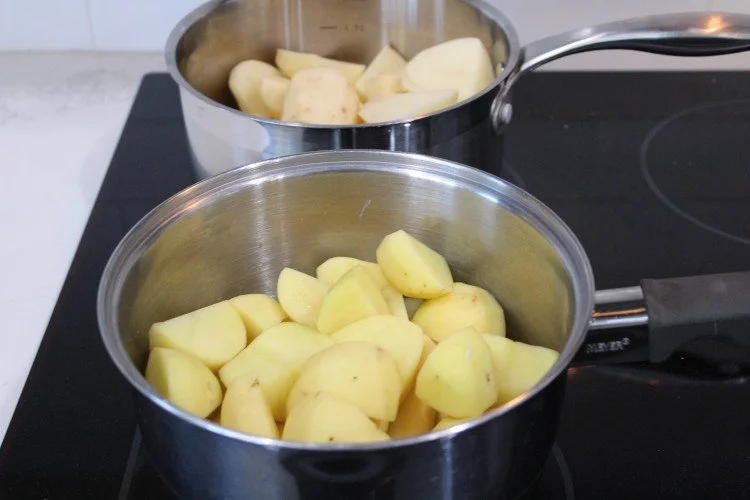
🥔 Mediocre Note: We went down one hell of a rabbit hole trying to figure out if Yukon Gold potatoes and yellow fleshed potatoes are the same thing. The best answer we could find is that Yukon Gold potatoes are a type of yellow fleshed potatoes. So, did we have Yukon Golds when we cooked mashed potatoes? Or did we have a different yellow potato varietal? 🤷
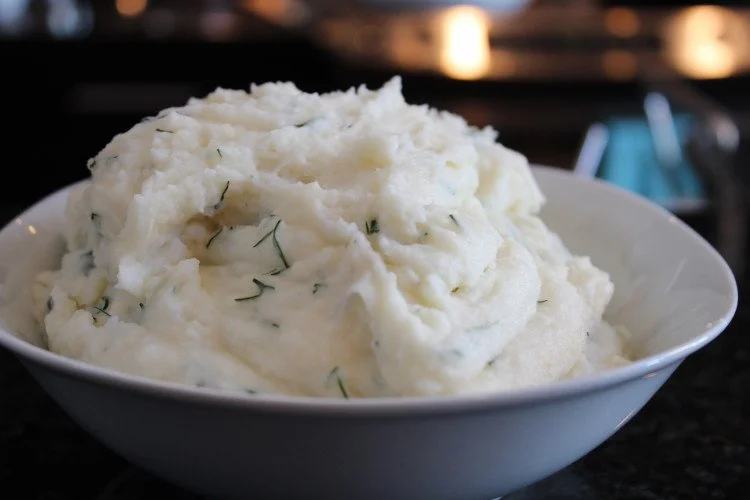
The first recipe is the garlic and dill mashed potatoes from our Canadian Thanksgiving post. We made two variations of this, both using boiled yellow potatoes. In one version we mashed them with a hand masher, and in the other version we used a potato ricer. We ended up preferring the potato ricer version — the texture was just better.
The second recipe we tried was from Spend With Pennies. In this one we made two versions — one with Russet potatoes and one with yellow potatoes. In both versions we boiled the potatoes and mashed them with a hand masher. We ended up preferring the look, taste, and texture of the yellow potatoes as opposed to the Russet potatoes.
The third recipe we tried is Trevor’s recipe for roasted garlic and rosemary mashed potatoes. In this test we baked Russet potatoes and boiled some yellow potatoes. For both of them we made a cream infusion of roasted garlic and rosemary.
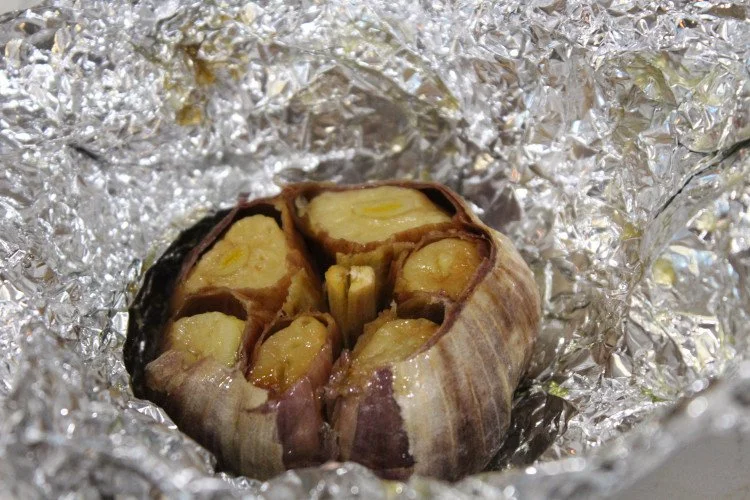
Garlic is love, garlic is life.
We ended up preferring the boiled yellow potatoes for their texture and colour. The baked potatoes had a sad white colour to them.
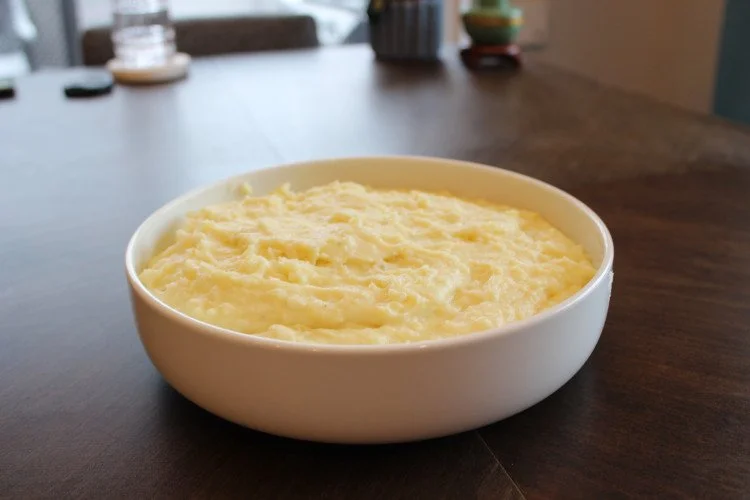
What our experiments told us is that boiling yellow potatoes and then using a potato ricer resulted in a mashed potato that we enjoyed the best.
Mashed Potato Theory 101
What do you do when you want to make your own mashed potatoes, but you don’t trust Gordon Ramsay or Jamie Oliver to give you the best recipe? Well, you statistically analyze 30 different mashed potato recipes on the internet to figure out what the optimal mashed potato is, of course. So that’s what we did just for you. You’re welcome. Yes, we are turbo nerds.
⚡ Lighting Fast Mashed Potato Numbers ⚡
63% of recipes used Yukon Gold potatoes (in fairness, some called for both)
93% of recipes boil the potatoes
60% of recipes used a hand masher
100% of recipes call for butter (thank God)
100% of recipes used an additional source of fat other than just butter
97% of recipes want you to not include peels in the final product
87% of recipes call for salt and pepper to season
79% of recipes don’t include a tasty cream/milk infusion
67% of recipes call for additional ingredients of some form (more on that below)
23.2g of butter per pound of potatoes is the amount of butter you’re aiming for
What type of potato is the best to use for mashed potatoes? 🥔
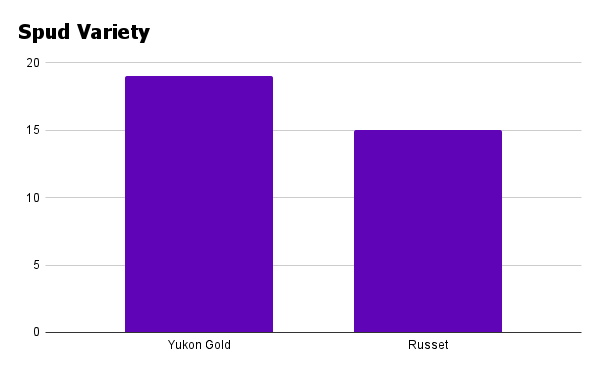
Yukon Gold! Or Russet, depending on who you ask. 17% of recipes called for either (Russet or Yukon Gold), and 7% called for half and half.
Of the recipes that only called for one type of potato, 60% called for Yukon Gold and 40% called for Russet.
Super waxy potatoes, like red potatoes, aren’t as good at being mashed as the two types of potatoes above. You can use them if you are desperate for mashed potatoes and it’s the only type of potato that you have, but just know that they won’t turn out as good as a super starchy potato.
How do you cook mashed potatoes? 🔥
Samwise said it best: boil ‘em.
93% of recipes called for boiling the potatoes. Now, what we didn’t look at was how many didn’t say reduce to a simmer after reaching a boil — we’ll update this post in the future with that information!
One recipe in our dataset had you bake the potatoes, then peel, then mash ‘em. It’s a lot of work. Peeling and boiling is so much easier! We also had one recipe called for a simmer (never boiling the water).
“Boil ‘em, mash ‘em, stick ‘em in a stew.”

What tool should I use to mash potatoes? 🥔
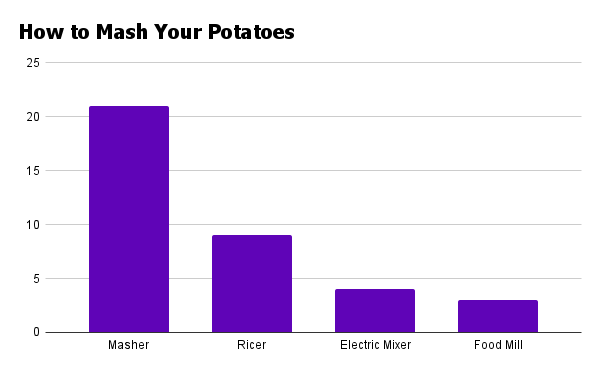
Masher. Ricer. Food mill. So many options!
Apparently some people even like to use an electric mixer, but we don’t recommend it — it’s an easy way to over-mash your potatoes.
57% of recipes called for a potato masher. That being said, some recipes said “ricer or masher” or “food mill or ricer”, so the chart below shows how many times the tool/processing method was mentioned.
Now the elephant in the room: is the popular tool, the best tool for the job? Well, it’s the most common tool for the job and it’s also the cheapest. It gets the job done.
But if you want fancy mashed potatoes, we recommend using a potato ricer for the creamiest mashed potatoes ever. It’s the only one-trick tool that we own for a reason.
Obligatory Disclaimer: This post contains affiliate links that help us earn a small commission from your purchase (at no extra cost to you). Each purchase supports the blog so we can continue to make content! If you use these links, we really appreciate it!
Do mashed potatoes need butter? 🧈
YES.
Next question.
How much butter should you use? 🧈
All of it.
Jokes aside, we decided to calculate just how much butter per potato you should use. Because we are awful (and also because if we kept it all as grams the numbers end up being small and harder to understand), the ratio is going to be in units of grams of butter per pound of potatoes.
We found that the median ratio of butter to potato is 23.2g/lbs. Why are we using the median and not the average? Because there was one very notable outlier in our data set (and also because our data isn’t normally distributed).
The recipe that used the lowest amount of butter per pound was this recipe, at 4.2g/lb. 👎 This is a very sad amount of butter.
On the other end of the spectrum, this recipe uses 172.5g/lb of butter. 🤯
Should you add extra fat to your mashed potatoes? 🥛
100%. Yes. Every single recipe requested an additional source of fat other than the butter.
Types of fat you can try: whole milk, heavy cream, cream cheese, sour cream, crème fraîche, mascarpone. Take your pick!

Should I peel my potatoes? 🥔
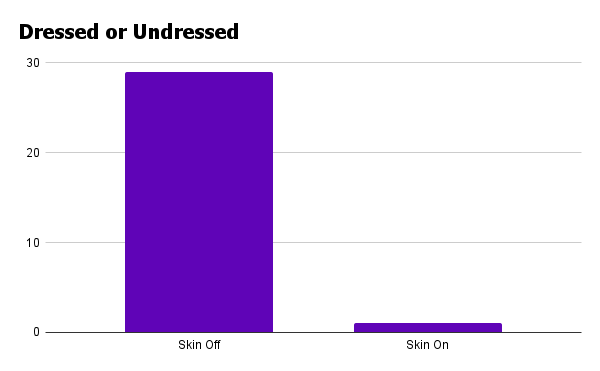
Yes. Only 1 of 30 recipes called for the skin to not be peeled. If you’re using Russet potatoes, absolutely peel the skin and don’t leave it on. It’s rough, and textured, and not pleasant.
The one recipe that did call for the peels left on was this Bon Appétit recipe, but they also used Yukon Gold potatoes which have a thinner skin. The recipe also claims that a ricer or food mill which will catch the skins, so you just get smooth mashed potatoes in the end. (We haven’t tested this.)
So essentially — if you want creamy, velvety mashed potatoes, peel your potatoes!
Salt and pepper? 🧂
This shouldn’t even really be a question, but we have to address it. 6.7% of recipes didn’t use salt and pepper and 6.7% only used salt. Thankfully, 86.7% of recipes called for both salt and pepper in their recipes.
Salt and pepper your food, kids.
Don’t make us say it again.

Should I be fancy and make an infusion with heavy cream or milk? 🥛
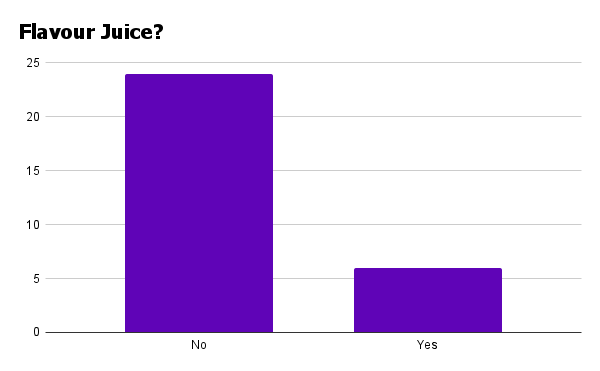
This is where we are going to diverge from the data again. 79% of the recipes suggest that you shouldn’t make an infusion. We disagree. We think that the best way to make your mashed potatoes even more flavourful is to infuse some cream or milk with herbs, seasonings, garlic, whatever your heart may desire. Does it require another pot? Yes. Will it take a little extra work? Yes. But the result is so, so worth it.
What else should I add to my mashed potatoes? 🤔
Turns out that most recipes want you to add something else. 67% of them to be exact. The top three add-ins that you should consider adding are garlic, chives, and parsley or rosemary (parsley and rosemary were tied for third place here).

How to Make the Best Mashed Potatoes
Wow, isn’t statistics fun?
“But what does it all mean?”, you ask. Well, based on our data, we created The Mediocre Chef Mashed Potato Blueprint. This isn’t a recipe, per se. Instead, think of it as a guideline for what makes a damn good pot of mashed potatoes.
The Mediocre Chef Mashed Potato Blueprint
Buy some Yukon Gold potatoes.
Peel and cut into even-sized chunks.
Boil them until they’re fork tender.
While the potatoes are cooking, heat up some cream, or milk (or whatever is easiest for your wallet) to get your flavour juice infusion ready. You’re aiming for about 100mL of liquid per pound of potatoes used. Yes we are diverging from the data. Sometimes the internet is wrong.
To the hot cream/milk add in 23g of butter for every pound of potatoes that you’ve used.
Also add in some crushed or minced garlic cloves and rosemary (or dill) to the flavour juice that you are creating.
Let that steep for 10-15 minutes to allow all the flavours to get to know each other. Remove the herbs and crushed cloves after it’s done being steeped. If you minced the garlic, you can leave it in there.
When the potatoes are done being cooked, strain them and then pass them through a potato ricer. Yet again we are diverging. Potato ricer > hand masher.
Once the potatoes are riced, slowly add in your flavour juice mixture. Remember, you can always add more flavour juice, but it’s hard to take it out.
When you’ve added all the flavour juice (or reached your desired consistency) add in some salt and pepper to taste.
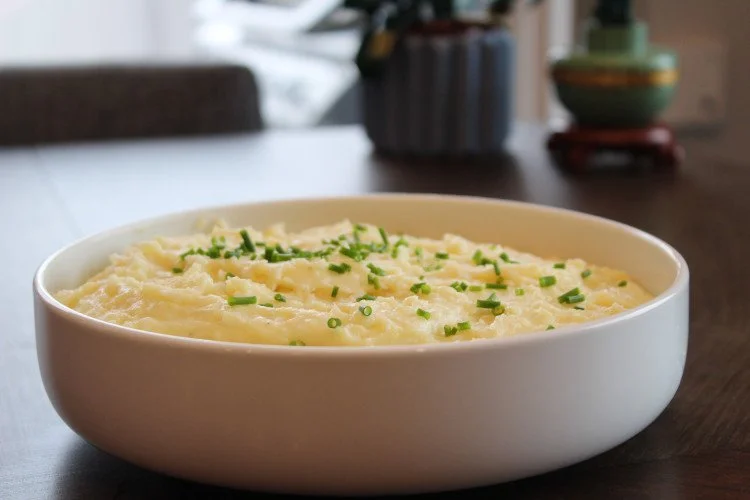
Garnish with chives and a pad of butter for a lovely presentation.
Bonus: Mashed Potato Tips
Cut your potatoes into bigger chunks so they don’t absorb as much water when boiling.
On that same note, boil your potatoes until they’re just fork-tender. Overcooking your potatoes can make them waterlogged, affecting the texture of the dish.
Mash (or rice) your potatoes while they’re hot! Don’t leave them sitting to cool. It’ll make it harder to mash. (Your arms will thank you.)
If you’re adding heavy cream or milk to your potatoes, heat it up gently in a pot on the stove first. This way it doesn’t cool down your mashed potatoes when you add it.
Don’t skimp on the butter! Also, many recipes call for unsalted butter, but if you have salted butter (which is often cheaper) go ahead and use it. You’re unlikely to over-salt your potatoes by adding salted butter.

Mashed Potato Sins 🙏
Forgive us Father, for we others have sinned. 📿
Note: It goes without saying, but don’t send any hate to these people. We are clowning on them in good faith.
Margarine? Instead of butter? In a mashed potato recipe? NO.
Sidenote: the price of butter right now is a crime.
No garlic? Also a crime.
Boiling garlic with the potatoes. Why? Why? For real, why? It ends up being the LaCroix of garlic mashed potato — the potatoes taste like they’ve been in the same room as garlic.
⅛ tsp of pepper for 4 pounds of potatoes? God forbid the mashed potatoes have flavour to them. (Don’t even get us started on the recipes that don’t include salt or pepper…)
So many recipes do this — asking for “3 large potatoes” or “5 medium potatoes”. Well, size is subjective (someone’s average potato is another person’s really huge potato). PLEASE USE POUNDS OR KILOGRAMS.
FYI we adopted the Mediocre Chef Potato Weight Standard when we were collecting our data (so we could calculate the amount of butter per potato). 1 large potato = 1 lbs, 1 medium potato = ½ lbs, 1 small potato = ¼ lbs. Is this accurate? We don’t know, we found a surprisingly well researched Stack Exchange answer that we used to get us to the simple numbers above.
Gordon, why are you asking me to drizzle olive oil on top of the mashed potatoes? There’s already so much fat in there. We don’t need olive oil on top. We don’t want olive oil induced diarrhea.
Chef Frank. We love you. Please include literally any measurements. Please.
For the love of god, commit to a recipe. Russet or Yukon Gold. Skin on or skin off. Cream or Milk. Mashed or riced. Pick a lane, Susan. We want a recipe, not a choose your own adventure. (We' are guilty of this too sometimes, we’re just memeing.)

Trevor’s Rant
How many potatoes do we need for this recipe? How about 8 cups worth.
Ricardo. Be so serious right now.
To insult us further you insist on being a good recipe developer including a metric measurement — 2 litres. Ricardo. Why can’t you be normal? Give me the measurement as a weight. Kilograms. Grams. Pounds. Ounces. Do you understand what I had to do to convert your nonsense to a weight? I had to look up sphere packing efficiency. Then I had to look up what the density of potatoes is. Good thing I have a degree in math, Ricardo. Someone gave this guy an app? Oh no.
If you made it to the end, hi. 👋 Thanks for reading our ultra-nerdy, totally scientific research on mashed potatoes.
Is there something we missed? Do you have a favorite mashed potato recipe? Let us know in the comments below!